A higher level of engagement
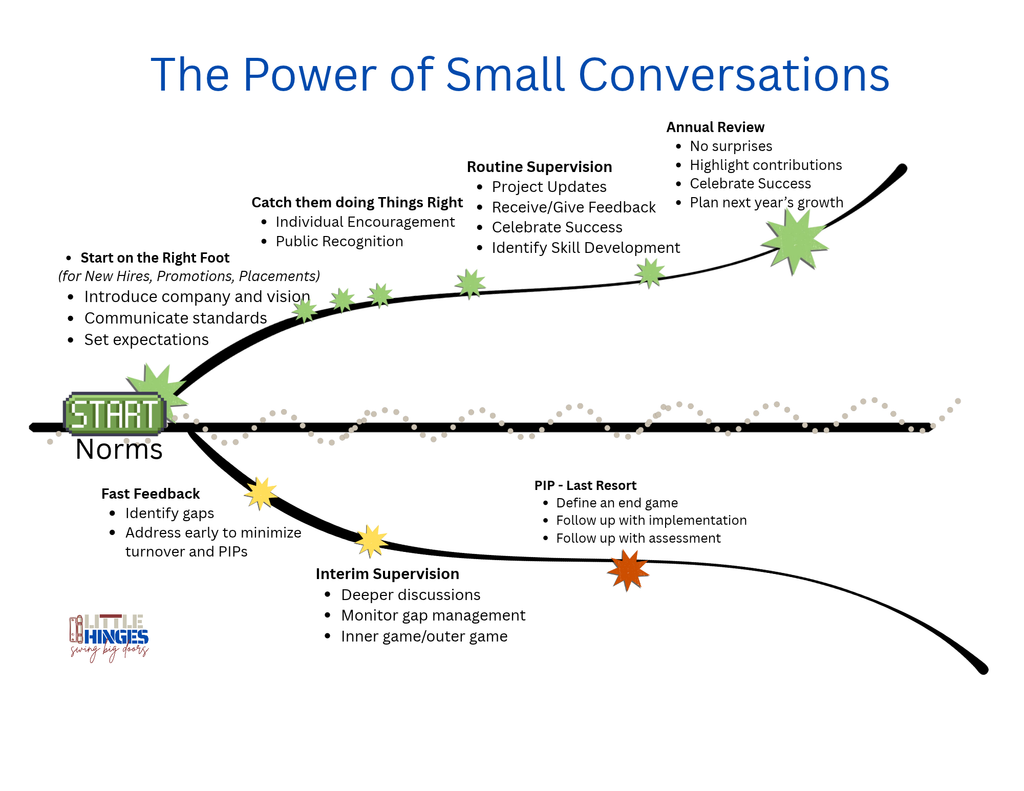
When mapped, it’s easy to see how many opportunities supervisors have for the small conversations that power up employee performance.
Are your supervisors ready for this level of engagement?
Why Small Conversations? A healthy dose of closeness
Outside Europe? View international editions.
Meet Donna, Principle Provocateur and Senior Coach
I am an expert in Training Development and desire to offer my services to Human Resources in Corporate America and US Government Agencies. With a masters in Instructional Design, I bring twenty years of experience to the design, development, and delivery of the skills development that managers need to engage performance conversations. As a top-tier facilitator of skills-based training for retail’s Fortune 100, from the design and implementation of performance management systems for the City of Boston and the Massachusetts Department of Revenue, to the re-design of leadership training for the Division of Human Resources and the state’s 3,000 managers, I have been provoking supervisors and managers enterprise-wide to build the conversational skills and operational know-how requisite of managing employee performance.
It can be done. Managers are hungry for the skills that promise success!
To do so, they need your investment in their professional development.
What do I bring?
Strategic and tactical: Identifying organizational needs while designing and implementing the solution
Skill Builder: Twenty years of L&D experience designing/delivering classroom, Virtual, and Online learning experiences
Relationship Builder: Partnering enterprise-wide
I am a Visionary
- Encouraging the conversation at hand – don’t wait!
- Provoking a new relationship between L&D and Performance Management
- Hawkish on change management theories and strategies
- A provocateur of positive, progressive change

Your Standards
Performance Management begins with the process of setting and maintaining standards. Standards that tell employees what success looks like. Standards that shape job descriptions.
Do your employees know what YOUR standards are?

Reinforcement
Research says an employee needs to receive positive feedback five times for every single conversation that delivers constructive feedback.
How, and how often, do your most senior leaders give positive feedback?
How do your supervisors celebrate success?
Are your supervisors willing to stop the task to give positive feedback—or do they think the employee is ‘just doing their job’?

Frequently Asked Questions
What is the purpose of a routine supervision?
Too often the ‘one-on-one’ serves to update the project. As importantly, it’s also a time to check in on how the employee is doing. What’s working well? What’s not, and why? These are the conversations that lead to meaningful development, greater motivation, and growth opportunities that build organizational pipelines and reduce turnover. How often are your supervisors meeting one-on-one?
How do you ease the annual reviews?
Once supervisors master the communication skills (including getting and giving feedback) and strategy that support small conversations, the annual review becomes a simple summary discussion. Often lush with insight, when these discussions identify and plan next year’s professional development, the perception of reviews that ‘go nowhere’ now ‘go somewhere’.
Why newly promoted junior manager often get discouraged?
The lack of training and the inability to establish report with their team is often a large factor in the discouragement of young leaders, who have not been properly trained to establish themselves. They will often leave before they seek internal help.
Why are my managers not being effective at keeping their teams happy and getting the work done in time?
When supervisors lack the confidence in having small conversations; they invariably wait too long to address under-performance resulting in an eroded relationship, loss of revenue, and potential turnover. By the time a PIP is put in place, the trust and rapport in the employee/supervisor relationship is at all-time low and the employee’s motivation to learn new skill has eroded. What is your cost of a new hire?